What Is The Clinical Utility Of The Faecal Bile Acids Assay?
The faecal bile acids assay can aid the diagnosis of bile acid diarrhoea in patients with diarrhoea-predominant irritable bowel syndrome (D-IBS) or function chronic diarrhoea, and support the differential diagnosis of bile acid malabsorption.
How Is The Assay Performed In The Laboratory?
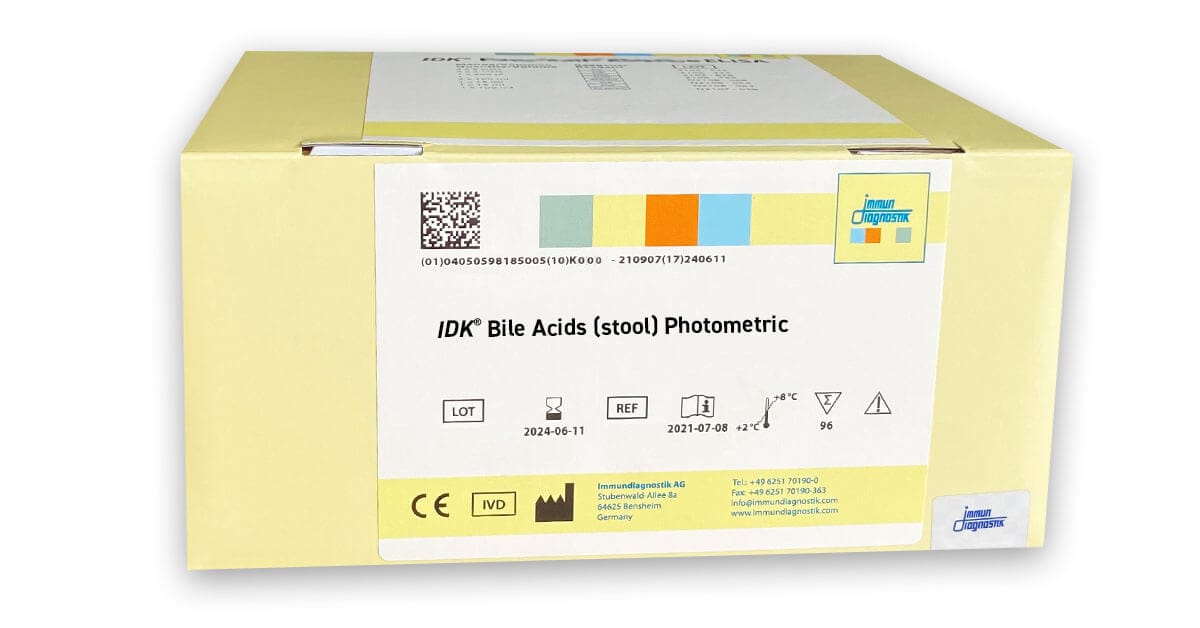
Total free bile acids are quantitatively measured in homogenized stool sample extracts using a 96-well colorimetric assay. The concentration of total bile acids in stool samples was derived by comparing to a standard curve.
How Long Does It Take To Get Results From The Assay?
The IDK Bile Acids assay provides rapid results, via a 96-well colorimetric assay that gives a quantitative measurement of total free bile acids in stool samples in just 9 minutes.
Is Patient Preparation Required Before Performing The Assay?
No special patient preparation is required. Patients can collect stools sample at home and send them to the laboratory for analysis.
Which Patient Groups Can Benefit From The Assay?
The assay is applicable to multiple patient groups including those presenting with idiopathic diarrhoea, irritable bowel syndrome (IBS), Crohn’s disease, post cholecystectomy, and coeliac disease. It may also be useful in patients receiving certain therapies that can cause bile acid malabsorption.
What Is A Faecal Bile Acids Assay?
The faecal bile acids assay is a diagnostic test that measures the levels of bile acids excreted in stool samples.
Why Is The Faecal bile acids assay Performed?
The assay aids the diagnosis of bile acid diarrhoea in patients with diarrhoea-predominant irritable bowel syndrome (D-IBS) or chronic functional diarrhoea to support the differential diagnosis of bile acid malabsorption.
Is The Faecal bile acids assay Invasive?
No, the assay is non-invasive and involves only the collection of stool samples. It can be combined with other routine faecal markers such as faecal calprotectin, faecal immunochemical tests (FIT tests), and faecal elastase for exocrine pancreatic insufficiency.
Are There Any Risks Or Side Effects Associated With The Faecal Bile Acids Assay?
No, there are no known risks or side effects associated with the Faecal bile acids assay.
What Are Bile Acids (BA)?
Faecal bile acids (BA) are bile acids that are excreted in stool because of a failure to reabsorb them in the intestine. Bile acids are produced by the liver, stored in the gall bladder, and excreted into the duodenum to aid digestion of fat. Normally, around 95% of bile acids are reabsorbed at the terminal ileum and returned to the liver via the portal venous system. When reabsorption fails, or too much bile is secreted, bile acids can transit through the colon and be excreted in faeces.
What Are The Main Bile Acids?
Bile acids are excreted in bile as cholic acid and chenodeoxycholic acid (primary bile acids). In healthy individuals around 5% of primary bile acids reach the colon where they undergo deconjugation, oxidation or dihydroxylation to form lithocolic acid, deoxycholic acid and ursodeoxycholic acid (secondary bile acids).
What Do The Different Levels Of Faecal Bile Acids Mean?
Raised levels of faecal bile acids can indicate problems with bile production, digestion, or absorption. For example, elevated levels of faecal bile acids may suggest malabsorption caused by disease (e.g. Crohn’s disease) or unknown causes, or could be related to surgery (e.g. cholecystectomy, terminal ileum resection). Bile acids are essential for the digestion and absorption of fats in the diet. If the liver is not producing enough bile or if there is a problem with the gallbladder or bile ducts, faecal bile acid levels may be low. Similarly, if there is a problem with the digestion or absorption of fats in the small intestine, faecal bile acid levels may be elevated.
What Causes Excess Faecal Bile Acids?
Excess faecal bile acids can be caused by several factors, including bile acid malabsorption, liver disease, and certain medications.
What Are The Symptoms Of Bile Acid Diarrhoea?
Symptoms of bile acid diarrhoea include frequent diarrhoea or loose stools, faster gut transit and increased urgency to defecate, faecal incontinence, abdominal pain, nausea, and fatigue.
Can Diet Affect Faecal Bile Acid Levels?
Yes, various dietary factors can affect faecal bile acid levels. For example, a diet high in saturated fats and cholesterol may increase bile acid synthesis in the liver, while a diet rich in fibre may promote the excretion of bile acids in the faeces. Additionally, some dietary supplements, such as psyllium husk and cholestyramine, can bind to bile acids in the gut and promote their excretion in the faeces.
What Is A Bile Acid Stool Test?
A bile acid stool test is a medical test that measures the levels of bile acids in a stool sample. It is used to diagnose conditions related to the liver and the digestive system.
What Is Bile Acid Diarrhoea (BAD)?
Bile acid diarrhoea (BAD) is a chronic debilitating condition in which excess bile acids are excreted in the faeces, leading to watery diarrhoea. This can be caused by a variety of factors, including malabsorption syndromes, inflammatory bowel disease, and previous gastrointestinal surgery. BAD is considered an underdiagnosed condition by experts and prevalence has been estimated at 1% of the UK population – similar to coeliac disease. It is thought that 25% of patients with diarrhoea predominant IBS (d-IBS) and up to 33% of patients with chronic diarrhoea suffer from BAD.
What Causes Bile Acid Diarrhoea?
Bile acid diarrhoea (BAD) can be caused by several factors, including bile acid malabsorption, gallbladder removal, and certain therapies (e.g. radiation and immunotherapy for cancer). There are four main types of bile acid diarrhoea: Type 1 – caused by disease, dysfunction or removal of the ileum; Type 2 – idiopathic (primary BAD) possibly caused by increased production of bile acids or dysregulation; Type 3 – Secondary to other gastrointestinal diseases or therapy that result in bile acid malabsorption.
What Happens If Bile Acid Malabsorption Is Left Untreated?
Bile acid malabsorption and bile acid diarrhoea can impair quality of life with sufferers reporting episodes of embarrassment, isolation, depression, and absence from work. If left untreated, bile acid malabsorption can also lead to malnutrition and other complications such a microscopic colitis.