Skip to content
Back To Our Shop

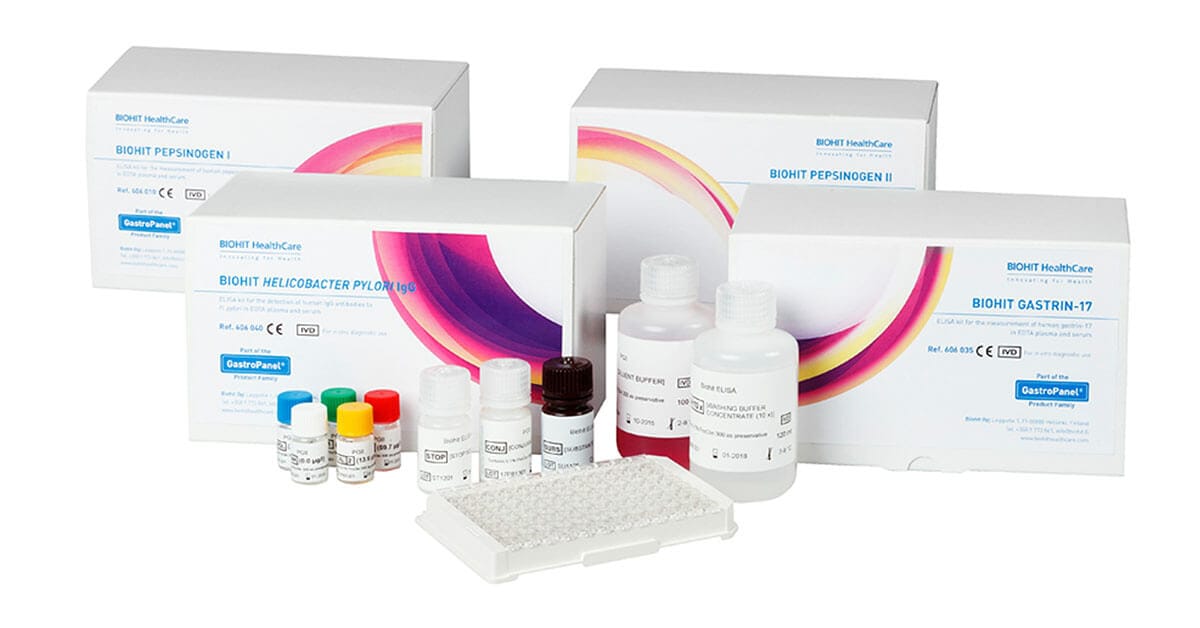
GastroPanel® (Pepsinogen I, Pepsinogen II, H. pylori IgG and Gastrin-17 ELISAs)

Most people experience stomach discomfort, upsets, or abdominal pain at some point throughout their lives and in the majority of cases these are caused by transient issues or functional dyspepsia.

Category:

Key Advantages

Reliable detection of healthy stomach mucosa, acid dysregulation, H. pylori infection and atrophic gastritis

Simple non-invasive blood test for primary care and screening settings

Aids patient management and referral

Helps to identify patients most at risk of gastric cancer, and target endoscopy resources towards those at greatest risk

Easily automated on ELISA automates (e.g. Dynex DS2)

GastroPanel® Blood Test for Dyspepsia, Atrophic Gastritis and Stomach Cancer Risk

Most people experience stomach discomfort, upsets, or abdominal pain at some point throughout their lives and in the majority of cases these are caused by transient issues or functional dyspepsia. Chronic stomach conditions however can indicate that an individual has a more significant health issue, and it’s necessary to conduct diagnostic tests. But these issues can be difficult to diagnose due to non-specific symptoms and limited tools available to investigate the cause. GastroPanel is a straightforward, early-detection blood test for gastric problems designed to help identify pathologies of the stomach mucosa such as chronic atrophic gastritis, Helicobacter pylori infection, and risk of stomach cancer, that can help healthcare providers implement successful treatment plans.

What is the GastroPanel® blood test?

GastroPanel blood test screens patients and guides their referral for endoscopy. It measures the levels of specific biomarkers in the blood, including pepsinogen I, pepsinogen II, gastrin-17, and Helicobacter pylori antibodies. These biomarkers provide information about the health of the stomach mucosa and the presence of H. pylori infection.

How does GastroPanel® work?

GastroPanel can be employed by laboratories and health clinics and is based on two technologies according to clinical need. Laboratories can choose from ELISA format or quantitative lateral flow test format to analyse the four plasma markers of GastroPanel – Pepsinogen I, Pepsinogen II, Gastrin 17 and H. pylori IgG antibodies. For clinics and GP practices, GastroPanel Quick Test NT is available as a finger-prick quantitative lateral flow test for the immediate analysis of the four plasma markers from a capillary blood sample.

Does the blood test detect stomach cancer?

GastroPanel is not a stomach cancer test. It is a test for the detection of the pre-cancerous condition of the gastric mucosa called atrophic gastritis which is the greatest known risk factor for gastric cancer and requires endoscopic follow up and biopsy analysis. Medical professionals carrying out the comprehensive stomach blood test will be able to interpret the test results quickly with the help of an interpretive algorithm (GastroSoft®), so patients can be triaged according to the risk and referred as required.

Is GastroPanel a blood test for gastritis?

Detecting inflammation of the stomach mucosa (gastritis) with a blood test is not easy, but the GastroPanel blood test can help. GastroPanel measures Helicobacter pylori IgG antibodies to help diagnose H. pylori infection, which if present can cause superficial gastritis. But GastroPanel also identifies the chronic phase of gastritis where the gastric mucosa has reached an advanced stage called Atrophic Gastritis. GastroPanel blood test results report the concentration of Pepsinogen I, Pepsinogen II, Gastrin 17 and H. pylori IgG antibodies in a blood sample, producing a comprehensive report for the healthcare professional to take swift action.

Is there a blood test for peptic ulcer disease (PUD)?

Currently, there is no specific blood test for peptic ulcer disease (PUD), however GastroPanel blood tests for gastric atrophy will indicate whether an individual is at risk of PUD based on the assessment of H. pylori infection, atrophic gastritis, and intragastric acidity.

How does GastroPanel help explore stomach acidity?

When a fasting blood sample is tested using GastroPanel and the results show negative H. pylori IgG antibody status, low gastrin-17 levels, and normal pepsinogen profile, it is indicative of high acid output which may be useful for determining the appropriate use of proton pump inhibitor (PPI) therapy and investigating acid related disorders such as gastroesophageal reflux disease (GORD). Conversely, GastroPanel also detects atrophic gastritis which causes hypochlorydria (low acid output) or achlorhydria (no acid output) which is an indication for gastroscopy and may be a contraindication for PPI therapy. Therefore, GastroPanel may prove to be a useful surrogate blood test for stomach acidity.

  • ELISA

  • 43 tests

  • Storage: 2-8 °C

  • Blood sample