What is Helicobacter pylori?
Helicobacter pylori is a spiral shaped gram negative bacteria that can infect the stomach and cause various gastrointestinal conditions. It has been shown to increase the risk of gastric cancer and cause peptic ulcer disease.
What are the symptoms of Helicobacter pylori?
Many people with H. pylori infection do not experience any symptoms. However, some individuals may develop symptoms such as stomach pain, bloating, nausea, vomiting, loss of appetite, weight loss, and in more severe cases, peptic ulcers, or gastritis.
How do you test for Helicobacter pylori?
There are several methods to test for H. pylori infection, and different tests are selected depending on the clinical situation and patient history. Non-invasive blood (antibody) tests are used in screening settings or first line while urea breath tests and stool antigen tests can be used to confirm active infection or successful eradication post treatment. Gastric biopsy tests are used in conjunction with gastroscopy and include histology and rapid urease testing (commonly known as CLO tests). Biopsy samples can also be used to determine the best antimicrobial therapy to treat the infection by culture or molecular tests. The choice of test depends on several factors, including the clinical setting, the patient’s symptoms, age, and medical history.
How do you perform the BIOHIT UFT300 H. pylori Quick Test?
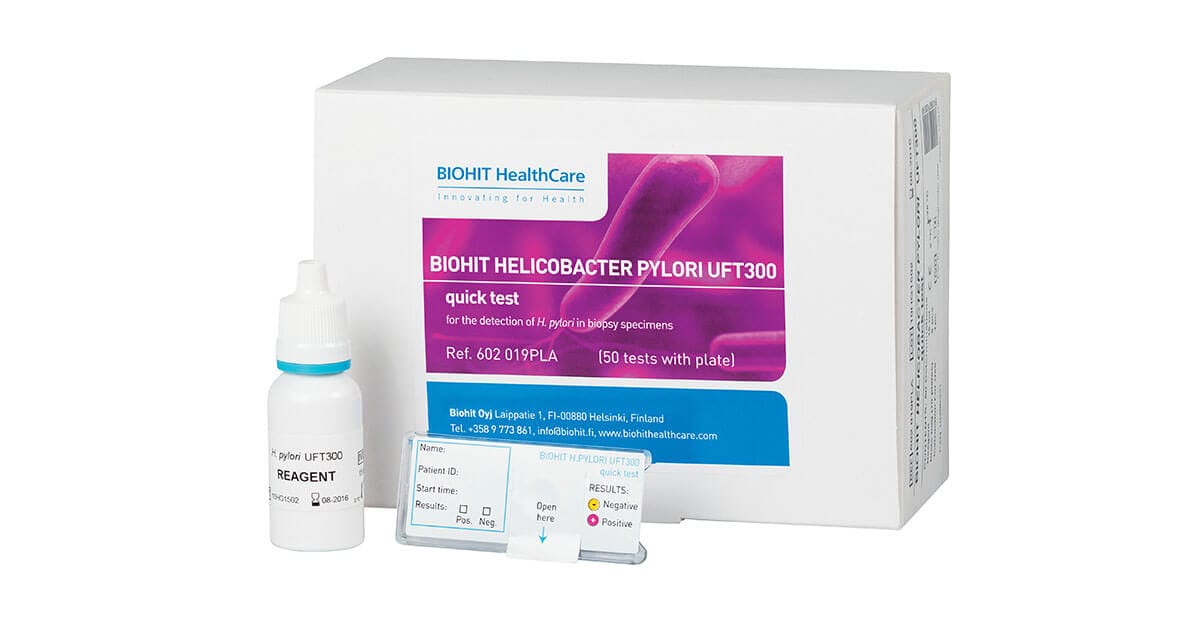
To perform the test, a biopsy sample is placed in the designated test plate. A single drop of the UFT300 reagent is added, the plate is sealed and gently swirled horizontally, and the results are read after 5 minutes. A positive result is indicated by a magenta colour, while a negative result is represented by yellow.
What are rapid urease tests used for?
Rapid urease tests are types of Helicobacter pylori tests that are used to diagnose the presence of H. pylori infection during upper gastrointestinal endoscopy (gastroscopy). They are also sometimes used in the follow-up of treatment to determine the effectiveness of eradication therapy.
What other types of tests are available for detecting H. pylori?
There are several types of tests available, for several sample types, including urea breath tests, stool antigen tests, antibody tests, and gastric biopsy tests via histology, rapid urease testing, culture or PCR.
How does a rapid urease test work?
Rapid urease tests diagnose the presence of H. pylori in a biopsy specimen by detecting urease enzyme activity produced by the bacteria. The test involves placing a biopsy sample in a test plate, adding a reaction buffer, and observing a colour change to determine the result.
How long does it take to get the test results?
The BIOHIT UFT300 H. pylori Quick Test is an ultra-fast urease test that delivers results within 5 minutes, allowing for fast diagnosis during gastroscopy procedures.
What does it mean if patients test positive for H.pylori?
A positive urease test result for H. pylori indicates the presence of the bacteria in the stomach. It suggests that the individual has an active H. pylori infection that may be the cause of their symptoms, and the patient should be considered for treatment to eradicate the bacteria and prevent potential complications.
How accurate is the BIOHIT UFT300 H. pylori Quick Test?
Studies have shown that the BIOHIT UFT300 H. pylori Quick Test has high accuracy, with sensitivity and specificity rates that are comparable to gold standard methods like histology or urea breath tests.
Does antacid or PPI therapy affect rapid urease tests?
Antisecretory therapies including PPIs and H2RA have been shown to reduce the sensitivity of urease tests. This is thought to be caused by altered distribution of bacteria in the stomach as a result of prolonged use of such therapies. Patients should pause antisecretory therapies prior to testing.
Is there a quality control available for rapid urease tests?
Yes, H. pylori Control+ is a positive urease control designed to verify the performance of rapid urease tests daily. These controls help ensure the reliability of the test results and help demonstrate high quality assurance for endoscopy services.
Are Helicobacter pylori tests suitable for all patients?
Helicobacter pylori tests can be used on patients of various ages. However, specific test methods and sample collection techniques may vary depending on the patient’s condition and age.