Skip to content
Back To Our Shop

SmarTest® FIT Home test (Preventis®)

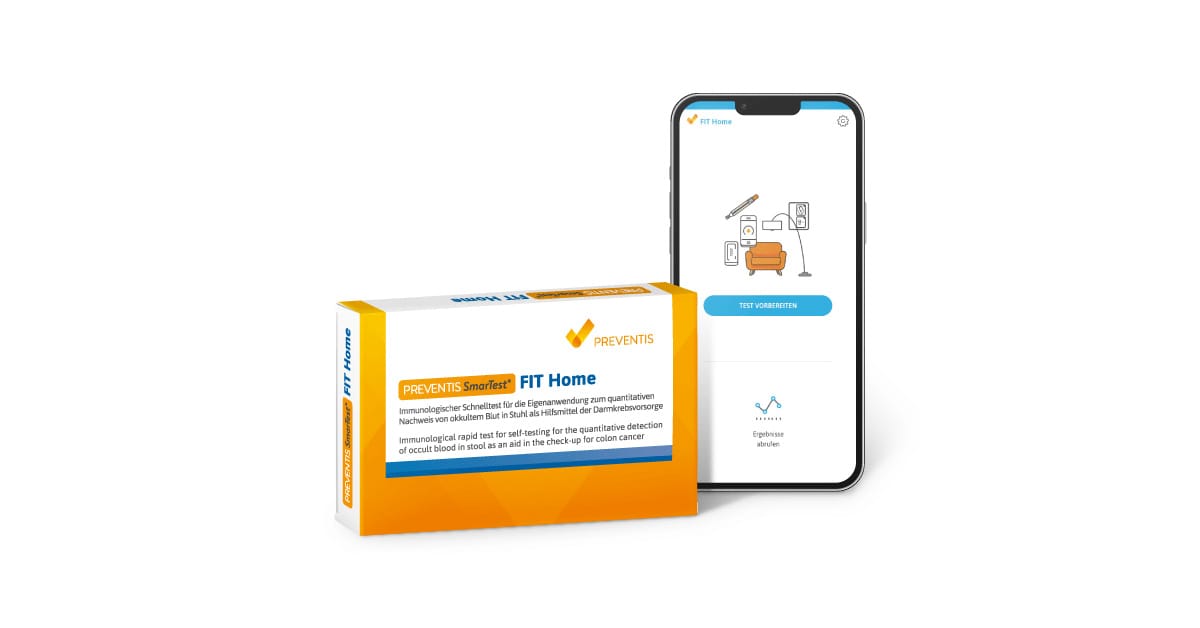
Preventis® SmarTest® FIT Home test is a quantitative home test system for measuring hidden (occult) traces of blood in stool samples. This in vitro diagnostic device (IVD) is intended for self-testing to support screening for colorectal cancer and adenomatous polyps in patients who may benefit from further investigations.

Category:

Key Advantages

Precise self test for home FIT testing

Rapid test with quantitative results in 15 minutes

Discreet and pocket sized packaging for testing anywhere.

Store at room temperature, no refrigeration required

Promotes Patient Initiated Follow up (PIFU)

Self-test for faecal haemoglobin levels at home with SmarTest® FIT

The detection of haemoglobin in stool samples can be used as a marker of gastrointestinal bleeding as part of a colorectal cancer screening initiative. Hidden traces of blood in the stool can originate from tumours or polyps (lesions) in the lower gastrointestinal tract so when haemoglobin is detected in stool samples it is indicative of the presence of such lesions and is a trigger for further investigation.

Studies have shown that when FIT (faecal immunochemical test) testing is employed and combined with confirmatory colonoscopy, precancerous lesion can be detected and treated in order to reduce mortality from colorectal cancer.

The Preventis SmarTest® FIT Home test system consists of a rapid immunological test and a smartphone app. The rapid lateral flow test detects human haemoglobin in stool samples using gold-conjugated anti-haemoglobin antibodies. The SmarTest app is then used to scan and analyse the faecal haemoglobin (FIT) test result according to the intensity of the control and test lines on the lateral flow test. The quantitative results of the test are then displayed in the app and available for discussions and follow up with healthcare professionals.

What is a FIT test?

FIT test stands for Faecal Immunochemical test and is the name given to any immunological diagnostic test that uses specific antibodies to detect human haemoglobin, a derivative of red blood cells, in a stool sample. FIT tests are used in colorectal cancer screening and for the investigation of patients presenting with abdominal symptoms suggestive of organic pathology.

How does SmarTest FIT Home test work?

The Preventis SmarTest® FIT Home test system includes a rapid immunological lateral flow test and a smartphone app. The rapid test detects human haemoglobin in stool using gold-conjugated anti-haemoglobin antibodies. The app, installed on a suitable smartphone, is then used quantitatively evaluate the result of the rapid test based on the colour intensity of the control and test lines. The quantitative FIT test result is automatically displayed and saved on the smartphone.

What does a positive SmarTest FIT Home test result mean?

Haemoglobin concentrations > 9.6 µg/g stool are interpreted by the test as positive, which means that human haemoglobin was detected in an amount that warrants further investigation. The presence of blood in stools can have many causes including bleeding intestinal polyps or tumours. However there are other common causes including menstrual bleeding, heavy bleeding of the gums, haemorrhoids, stomach irritations or blood in the urine. The evidence of blood provided by FIT Tests is therefore not directly equivalent to a medical diagnosis of colorectal cancer. SmarTest FIT Home test is just one test in a necessary series of tests to enable the doctor to make a complete diagnosis. It is therefore recommended that positive results are reported to a doctor as soon as possible in order to classify the results of the rapid test.

How accurate is SmarTest FIT Home test?

The analytical sensitivity of SmarTest FIT Home test (limit of detection) is 2.1 µg haemoglobin/g stool. The measuring range is 2.1 to 70 µg/g. In terms of analytical specificity the test shows no cross-reactivity with haemoglobin of animal origin.

With a cut-off at 9.6 µg haemoglobin/g stool SmarTest FIT® Home shows a clinical specificity of 93.0% and a clinical sensitivity of 31.5% for advanced neoplasia (colorectal carcinoma and large adenomas). With this cut-off the expected positive rate in an organised colon cancer screening (= screened representative selection of collected stool samples) is 10.4% [Gies et al., 2018].

  • Lateral flow test and App

  • Easy to follow and animated instructions

  • Individually packaged tests

  • Storage: 16-30 °C